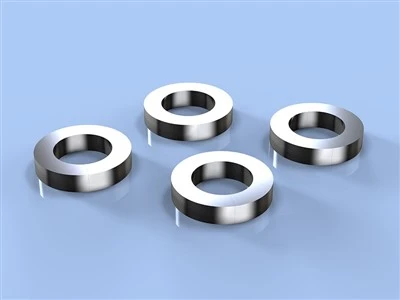
Permanent magnet materials used in wireless charging systems serve two purposes: Firstly, they enhance the magnetic flux between the transmitting and receiving coils, improving transmission efficiency; secondly, they act as a positioning device between the transmitter and receiver, facilitating rapid and accurate positioning of the terminal device. Small wireless charging devices often use NdFeB permanent magnet materials; larger wireless charging devices can use permanent magnet ferrite materials instead of NdFeB permanent magnet materials to reduce costs. For example, the University of British Columbia (UBC) uses non-contact dynamic magnetic coupling or MDC methods, utilizing the interaction of the magnetic fields of two rotatable permanent magnets to achieve EV wireless charging at a distance of 102mm to 152mm.
Single-coil free-position charging devices have coils with driving mechanisms that can move in a plane. They automatically detect the placement position of the terminal device and move the coil to that position, aligning the coil's position with the terminal's receiving position. This achieves charging and improves charging efficiency. This design allows the terminal to be placed anywhere on the charging pad for charging. The Qi standard specifies that this type of charger operates at a frequency of 140kHz. Because the coil needs to move, the magnetic shielding sheet requires high reliability; therefore, flexible magnetic sheets made using a casting process are generally used for the magnetic shielding sheet.
Multi-coil free-position chargers can charge multiple devices simultaneously. They contain multiple coils that cover a large portion of the charging dock. This allows devices to be placed relatively freely on the dock, and the charger automatically selects several coils with high power transmission efficiency. According to the Qi standard, multi-coil free-position chargers operate at frequencies from 105kHz to 113kHz, and the magnetic shielding sheet is typically made of MnZn power material with high Bs and low loss characteristics.