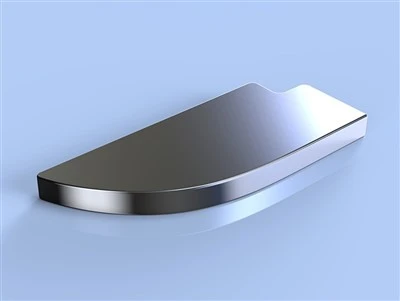

In the high - tech landscape of the defense industry, every component plays a crucial role, and NdFeB sector magnets are no exception. As a supplier of NdFeB sector magnets, I've seen firsthand how these powerful magnets are revolutionizing the defense field. Let's dive into some of their key applications.
1. Guidance Systems
Guided missiles and smart munitions are the future of warfare, and NdFeB sector magnets are at the heart of their guidance systems. These magnets are used in gyroscopes and accelerometers, which are essential for determining the orientation, position, and movement of a missile or a smart bomb.
Gyroscopes work based on the principle of angular momentum. The NdFeB sector magnets provide a strong and stable magnetic field that helps maintain the precise rotation of the gyroscope's components. This allows the guidance system to accurately measure the missile's angular velocity and orientation in real - time. With the high magnetic energy product of NdFeB magnets, the gyroscopes can be made smaller and more sensitive, improving the overall accuracy of the guidance system.
Accelerometers, on the other hand, use the magnetic force generated by NdFeB sector magnets to measure the acceleration of the missile. By detecting changes in acceleration, the guidance system can adjust the missile's trajectory to ensure it reaches its target accurately. For example, if a missile encounters wind resistance or other external forces during flight, the accelerometer can sense the change in acceleration and send signals to the control fins to correct the course.
2. Radar Systems
Radar is a vital part of modern defense, used for detecting and tracking enemy aircraft, ships, and other objects. NdFeB sector magnets are used in the traveling - wave tubes (TWTs) and klystrons of radar systems.
TWTs and klystrons are types of vacuum tubes that amplify microwave signals. NdFeB sector magnets are used to generate the magnetic field necessary for the operation of these tubes. The strong magnetic field focuses the electron beam inside the tube, allowing efficient amplification of the microwave signals. This increased amplification improves the range and sensitivity of the radar system, enabling it to detect smaller and more distant targets.
Moreover, the compact size of NdFeB sector magnets allows for the design of more portable and lightweight radar systems. This is especially important for military applications where mobility and ease of deployment are crucial, such as in field - based radar units or on small naval vessels.
3. Magnetic Separation in Defense Manufacturing
In defense manufacturing, the production of high - precision components requires strict quality control. Magnetic separation is a technique used to remove ferromagnetic contaminants from raw materials and finished products. NdFeB sector magnets are used in magnetic separators due to their strong magnetic field.
For example, in the production of aerospace components for military aircraft, the presence of any ferromagnetic particles can cause serious problems such as wear and tear, and even component failure. Magnetic separators with NdFeB sector magnets can effectively remove these contaminants, ensuring the quality and reliability of the final products.
4. Electric Propulsion Systems
Electric propulsion systems are becoming increasingly popular in naval and unmanned underwater vehicles (UUVs). NdFeB sector magnets are used in the electric motors of these propulsion systems.
The high magnetic strength of NdFeB magnets allows for the design of more efficient and powerful electric motors. These motors can provide higher torque and better power - to - weight ratios compared to traditional motors. In naval applications, this means that ships can achieve higher speeds with less fuel consumption, increasing their operational range and reducing their environmental impact.


For UUVs, the high - efficiency electric motors powered by NdFeB sector magnets enable longer mission durations and more precise control. The compact size of the motors also allows for smaller and more stealthy UUV designs, which are crucial for intelligence - gathering and surveillance missions.
5. Electronic Warfare Systems
Electronic warfare involves the use of electromagnetic energy to disrupt or deceive enemy electronic systems. NdFeB sector magnets are used in various electronic warfare devices, such as jammers and detectors.
In jamming devices, NdFeB magnets are used in the power amplifiers to generate the high - power electromagnetic signals needed to disrupt enemy communications and radar systems. The strong magnetic field provided by these magnets helps in efficient signal amplification, ensuring that the jamming signals can cover a wide frequency range and a large area.
Detectors also rely on NdFeB magnets to sense and analyze enemy electromagnetic signals. By using the magnetic properties of the magnets, these detectors can accurately measure the frequency, intensity, and direction of the incoming signals, providing valuable intelligence for military operations.
Other Shapes of NdFeB Magnets at Your Service
If you're interested in other shapes of NdFeB magnets, we've got you covered. Check out our NdFeB Sphere Magnet, which has unique magnetic field distributions and can be used in specialized applications. The NdFeB Tile Magnet is great for applications that require a flat and large - area magnetic field. For those who need magnets with an adhesive backing, our Adhesive NdFeB Magnet is a convenient option. The NdFeB Disc Magnet is widely used in various electronic and mechanical systems, and the NdFeB Block Magnet offers a simple yet powerful magnetic solution.
If you're in the defense industry and looking for high - quality NdFeB sector magnets or any other shapes of NdFeB magnets, feel free to contact us. We're dedicated to providing you with top - notch products and excellent service. Whether you need a small batch for R&D or a large - scale order for production, we can meet your requirements.
References
- "Modern Defense Technology Handbook", various authors
- "Magnetic Materials in High - Tech Applications", published by a leading scientific press